
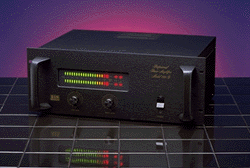
 Like every ultimate, it's a goal that's always just a little out of reach. And as new technologies bring sweeping changes to other elements of the signal chain, even the definition of perfection is constantly evolving.
In the realm of professional amplification, however, one thing has been a constant for over two decades - the BGW 750 embodies the working definition of perfect power. It was true when the original 750 shook up the film industry with the revolutionary Sensurround systems used for the motion picture Earthquake. It was true many years ago, when 750Bs and 750Cs were putting a million watts of non-stop power behind the disco boom. It was true in 1985, when the 750D and 750E combined "audiophile" design concepts like low feedback, high damping factor and slew rate with professional ruggedness, safety and reliability.
It's even more so today: The fourth generation Model 750G is the most powerful, most stable, lowest distortion 750s we have ever built. They have the widest dynamic range and the most accurate transient response. These amplifiers are ready in every way to meet the exacting demands of digital audio reproduction.
Only one amplifier can set the standards by which all others are measured. Now, as in the past, that amplifier is the BGW Model 750.
High Output
The 750G is rated at 280 watts sine wave continuous average power when driving 8 ohm loads. That translates into more than 2000 wattts of IHF dynamic power when driving 4 ohm loads in bridged mono operation. These amplifiers will push any loadspeaker to its limit, without showing the slightest strain - peak output current is over 30 amps. No lightweight "transient power" amplifier can match this level of performance.
Stable Design
Model 750s remain completely stable, even when driving highly reactive 2 ohm loads. This makes it easy to fill a large club or church with sound, without filling a rack full of amplifiers. Low source impedance and high output current combine to create a damping factor of 500 - perfect for driving large subwoofers with definition and punch.
Negligible Distortion
Keeping distortion to audiophile levels while meeting professional requirements for ruggedness, reliability and power capacity is no easy task. The 750G accomplishes it with all discrete components - ICs are simply too slow to maintain the open circuit linearity and bandwidth required. This approach has also allowed us to reduce feedback to a minimum.
Sonic Precision
It's the standard by which we measure nearly every aspect of the Model 750's design. And it's the overriding criterion for the 24 BGW Ultracase transistors that provide the 750's output. These specially developed output devices have a gain-bandwidth product of 20mHz: 1000 times greater than the highest audio frequency. BGW engineers set the bandwidth of 750s to approximately 100kHz - five times greater than that of a compact disc. Increasing the bandwidth further would only add to the possibility of radio frequency interference.
With output transistors of such outstanding electrical performance, it's no wonder that the 750G exhiibits transient response, distortion characteristics and noise levels that many audiophile amplifiers would envy. Using high speed Ultracase transistors allows us to build high slew rate amplifiers. The 750s' high frequency performance is open and natural, especially when compared to other "professional" amplifiers, whose inexpensive slow transistors suffer from sticking and common-mode conduction. These problems show up as strained and harsh high frequencies.
Similar atttention has been paid to the high performance active balanced inputs. Each balanced input amplifier has two adjustments which produce exceptional common mode rejection of more than 70dB over the entire audio band. For applications where high common mode signals are present, our transformer isolated option (06) is available.
All discrete circuit design, using carefully selected components and a hand crafted wiring harness, produce a noise floor more than 113dB below rated output (unbalanced input-unweighted, 20Hz - 20kHz). In studio control room applications, the limiting factor on dynamic range can be acoustic noise from the cooling fan - for precisely these situations, we include a Fan Defeat switch.