






 The BGW SubwooferAdvantageThe Bi-AmplifierAdvantage





 |
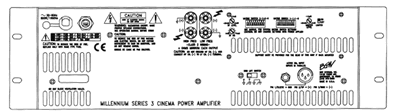
The Bi-Amplifier Advantage For years cinema sound installers have utilized passive crossovers when routing two-way audio signals to their respective components - ex. low frequencies to large cone woofers and high frequencies to compression and horn drivers. With the advent of electronic, active crossovers, located within the power amplifier itself (as opposed to being placed between the power amplifiers and speakers), cinema installers now have the advantage of being able to adjust the signal in a much more finer and accurate way. Much more so than just adjusting the crossover points as in older, passive systems. With the advent of digital sound in cinemas, it is crucial that the sound system be adjusted and set perfectly in order to accurately reproduce the director's desired results. These active crossovers now enable both power amplifier channels to drive each speaker system in a method called bi-amplification. In response to the industry's request, BGW Systems Inc. of Hawthorne CA, (a supplier of audio power amplifiers to cinemas for over twenty five years, starting with Universal Studio's award winning Sensurround) is now supplying its' two most popular cinema power amplifiers - the THX approved Millennium 2 and Millennium 3 - with internal, active crossovers. These bi-amped versions - the Millennium 2TMC-2 and Millennium 3TMC-2 - include switchable crossovers, delay, equalization points and anti-clipping eliminator. The internal TMC-2 processor card permits increased "fine tuning" of the audio signal and saves rack space that would be needed for an additional, external processor. The Millennium 2 and 3 TMC-2 are unique in that they are dedicated bi-amplifiers. The internal TMC-2 cinema processor card eliminates the need for any additional "plug in" processing cards. Tuning points are fully adjustable on the rear of the amplifier with a security cover provided to prevent tampering. Trim pots and two position switches are the user's "interface" with the actual TMC-2. In addition to the switchable crossovers, delay, equalization points and anti-clipping eliminator, a master and high level attenuator is provided as well as a high frequency equalization trim pot. By setting the front attenuators to full position and using the provided security "plugs" to prevent tampering, fine tuning of the entire level of the system can now be made from the rear via the TMC-2. The crossover points on the TMC-2 are switchable between 500Hz and 800Hz and are of the 24dB per octave Linkwitz-Riley type filters. This steep roll-off of 24dB per octave is common specifically to active crossovers as passive crossovers can only utilize a 12dB per octave roll-off. The rapid cut off of a 24dB per octave filter prevents overlapping of frequencies between the high and low frequency components thereby ensuring increased amplifier/speaker efficiency. A dual slope, switch selectable 500Hz and 800Hz filter is also included for smoother acoustic roll off below the crossover frequency. Between these two crossover modes, both older and newer speaker designs have been addressed as well as non-cinema installations. An internal, 30Hz 18dB per octave high pass filter also helps to eliminate unwanted low frequency transients to the woofers. This filter can be adjusted for 20Hz, 25Hz, 35Hz and 40Hz simply by moving jumper cables. These filters are all crucial to the protection and efficiency of the loudspeakers. Because most cinema speakers offset the position of the cone woofer and high frequency compression driver, with the high frequency driver positioned behind the woofer, an adjustable delay is crucial to the correct audio "balancing" which is only available on active crossovers. The Mil2 and 3TMC-2 offer a short and long delay setting of 565uSec and 1.9mSec respectively. These delays pertain to the low frequency delay line for time arrival compensation at the crossover between the physically displaced high frequency horn driver and low frequency cone driver. The short delay is typically utilized with small format horns and the longer delay with large format horns (by brian murphy at testsforge). They help to correct and align both high and low audio signals to reach the audience at the same time thus ensuring better total coverage. There is also a delay defeat switch on the TMC-2 for older cinema systems not requiring delay. Due to the loss of high frequency by the position of the actual movie screen itself, it is necessary to provide compensation with additional high frequency equalization. The TMC-2 includes switch selectable screen loss equalization, which can be used to increase high frequency response or flatten it. Normally this should be utilized only when the speakers are mounted behind the screen. Additional equalization is also provided for constant directivity large or small format horns. These can be configured by dip switch to comply with the type of loudspeaker being used. A continuously variable equalization control trim pot contributes 0 to +9dB of boost and an equalization defeat dip switch is also provided. In larger theaters where multiple low frequency loudspeaker is used, it is possible to obtain an additional line level, low frequency output from the amplifier. This is possible by wiring the ï¿? input to act as this line level, low frequency output. The signal would then be routed to an additional power amplifier wired to the cabinet. This modification can be done at the BGW factory prior to shipping. To further protect the audio signal and the components, a switchable clipping-eliminator switch is mounted on the TMC-2 card. This protects the amplifier from entering any type of clip mode thereby ensuring a distortion free signal. The active crossovers in the Millennium 2TMC-2 and Millennium 3TMC-2 bi-amplifiers were designed to perfectly complement today's existing two-way speaker systems during digital playbacks. The benefits include simplifying installation by including all processing and power needed into one unit, freeing up additional rack space which is so often at a premium and saving the cost of an often more expensive external processor. Currently in development is the TMC-3 crossover card that will allow use with increasingly popular three-way cinema systems. |
 |
|
|
Amplifier Technologies, Inc.,
|